.png)



Fraud controls aren’t one-size-fits-all. A new company issuing their first cards has different needs than an established program processing millions of authorizations a month. Both, however, deserve protection that’s serious, programmable, and natively built into their issuing processing infrastructure, the core philosophy of Lithic’s Authorization Intelligence.
Today, we’re excited to officially launch Fraud Essentials and Fraud Command. Together, they cover the full spectrum of what card programs need to protect cardholders, reduce losses, and operate with confidence. Fraud Essentials codifies the robust, out of the box controls that programs on Lithic have reliably used for years. Fraud Command is an advanced tier of sophisticated decisioning features for programs that have outgrown standard controls and need more expressive, data-driven rules without taking on the infrastructure complexity to get there.
Fraud Essentials: A Proven Foundation
Fraud Essentials gives every program on Lithic a baseline, always-on layer of fraud protection that’s intuitive, easy to configure, and requires no heavy lifting to get started. It includes the ability to configure core rule types (like setting conditional triggers or capping velocity limits) using standard rule inputs such as MCC, country, merchant descriptor, network risk score, and more. These rules apply across not just card authorization, but to 3DS authentication and ACH payments as well (depending on your program’s utilization of these touchpoints). And for digital wallet provisioning, the Essentials package lets programs seamlessly leverage all the wallets’ core decisioning requirements and security best practices, completely out of the box.
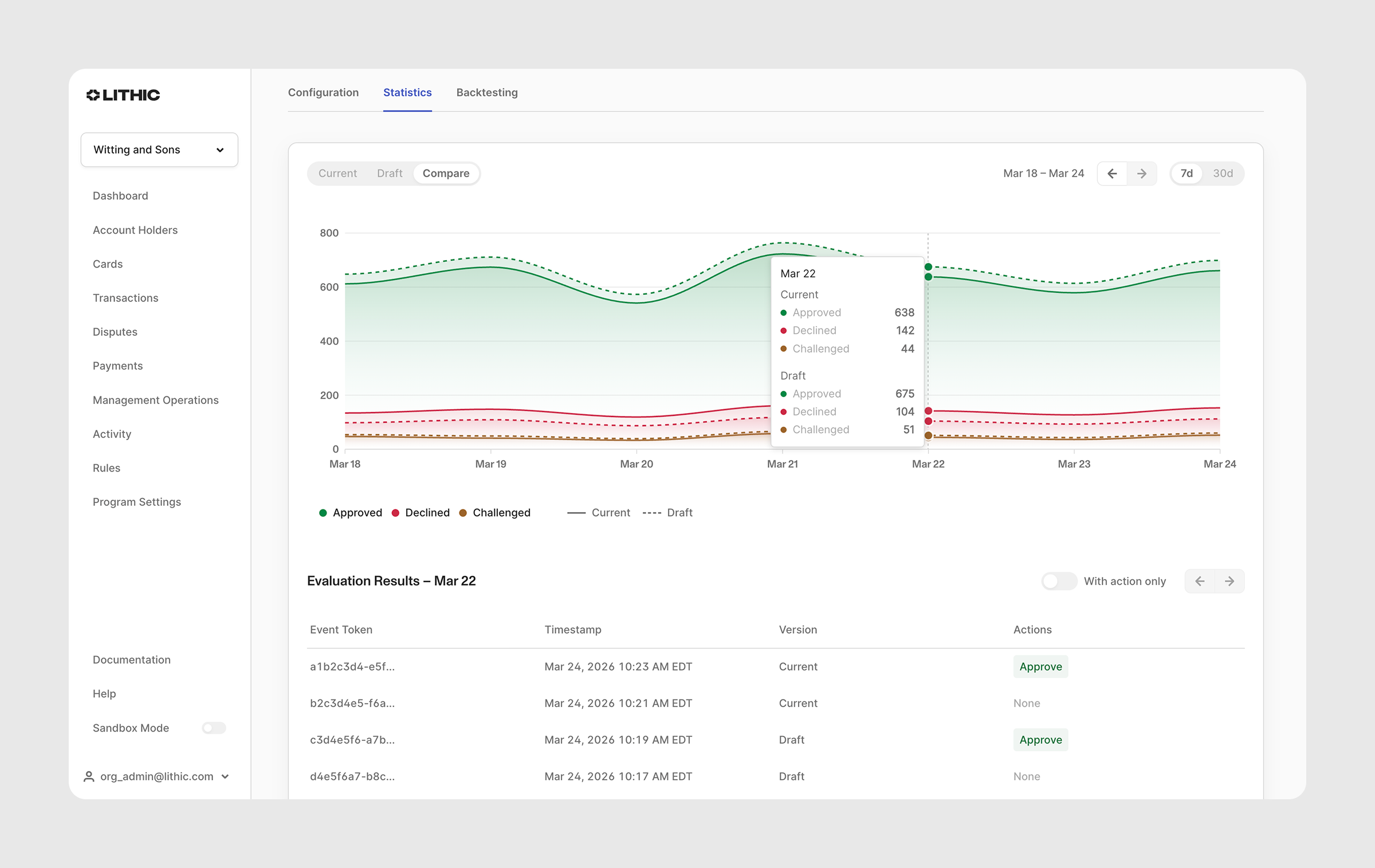
At Lithic, we believe that testing and analytics are crucial to any good fraud strategy. With Fraud Essentials, shadow mode testing and performance analytics are now available in the Lithic Dashboard for every Lithic program. Shadow mode lets you test a rule’s real-world impact against live traffic before it touches a single transaction. Watch the analytics, build confidence, then promote it live when you're ready.
Fraud Command: Precision Without the Overhead
Fraud Command is for programs that need the deepest level of control over fraud and their decline rates. It includes everything in Fraud Essentials, plus key capabilities that make decisioning more precise, contextual, and testable. Most features are available across multiple stages of the transaction lifecycle (wallet tokenization, 3DS, card authorization) as well as ACH; there are a few event-specific features as well.
Authorization Challenges
Every suspicious transaction presents a risk-based trade-off for programs: either approve a potentially fraudulent transaction or decline a legitimate cardholder’s purchase. Authorization Challenges solve that binary approve-or-decline decision. When a transaction appears suspicious but isn't conclusive, programs can require cardholders to verify via SMS, creating a third path that protects against fraud without penalizing real customers.
Contextual Rule Inputs
Rules in Fraud Essentials operate on static attributes: MCC, country, transaction amount, etc. Fraud Command adds behavioral context (e.g., spending patterns, account lifecycle signals, historical transaction data) evaluated at the moment of authorization. That means rules can express conditions like challenging transactions that are more than several standard deviations above the cardholder’s average spend; not just hard caps that inadvertently block legitimate spend. What might be normal behavior for one cardholder may be highly risky for another.
Custom Code Rules and AI Rule Assistant
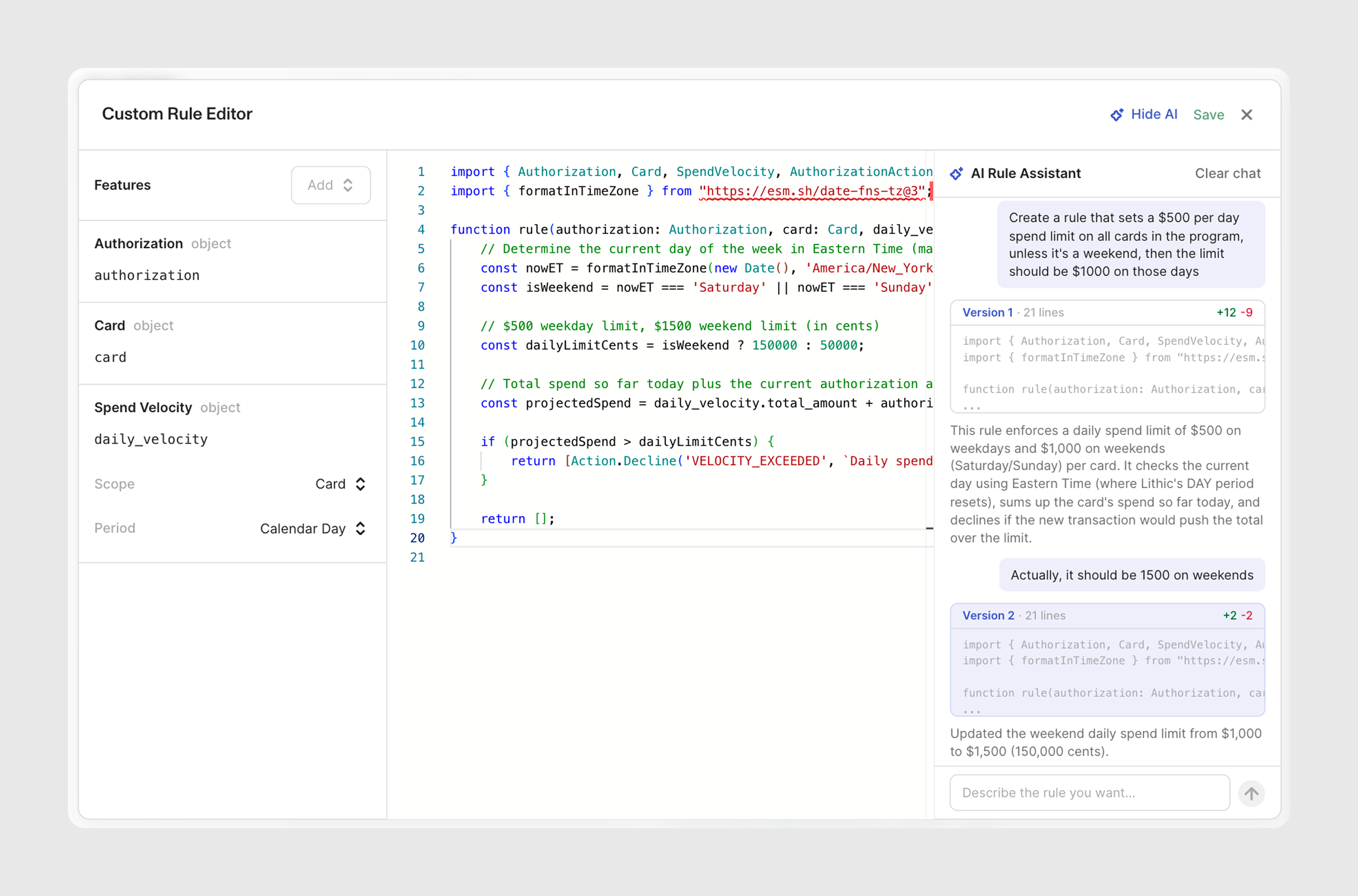
For programs that need to go beyond the standard rule builder (e.g., conditional actions and velocity limits), Custom Code Rules let teams write decisioning logic directly in TypeScript and express conditions that no template-based rule builder could accommodate. Compiled by Lithic, hosted on Lithic's infrastructure, and with the full context available across transaction, card, account, and merchant dimensions, Custom Code Rules unlock true rule nuance and precision without the infrastructure overhead.
Lithic’s AI Rule Assistant extends that capability further: describe the rule you want in plain language and Lithic’s AI writes the supporting TypeScript, putting sophisticated custom logic within reach of any team regardless of engineering resources.
Backtesting
Take any draft rule, run it against months of real historical transaction data, and see exactly what it would have caught before it ever affects a single live authorization. A velocity limit that looks right on paper may be flagging thousands of legitimate transactions. A merchant block may be catching almost no actual fraud. Backtesting surfaces that signal in minutes rather than requiring weeks of shadow mode accumulation. Backtesting doesn't replace shadow mode, but it dramatically compresses the path to confident deployment.
.png)
Tokenization Rules
The default decisions from networks and mobile wallet providers are a strong baseline, but they don't know the nuances of your program. Fraud Command lets programs apply their own program, account, or card-level rules to digital wallet card provisioning, strengthening defenses against unrecoverable fraud before a transaction ever reaches authorization.
What's Next
The team is currently building a pre-configured Rule Library: a curated set of rules that programs can apply directly from the Lithic Dashboard without writing any logic from scratch. Looking further into the year, Fraud Command will expand to include embedded device fingerprinting, advanced ML risk scoring, and more dynamic signals across the transaction lifecycle.
Getting Started
Fraud Essentials is active for every program on Lithic today. To add Fraud Command, reach out to your account manager or contact our team. Read our Fraud Command documentation to learn more.
See Lithic for yourself. Schedule a chat with an expert from our team. Talk to our team →