Review, Resolve, and Rest Assured: Lithic Transaction Monitoring is Now Live
.png)
.png)

Card programs are required by their sponsor banks to monitor transactions for suspected fraud and financial crime activities, flag anomalies, and manage cases through to resolution. It’s a compliance obligation every program carries, yet one that’s historically been hard to fulfill without significant operational undertaking. Most programs have solved it one of two ways: integrating a standalone monitoring vendor and building the data pipelines to connect it to their issuer processor, or relying on a program manager to handle it as part of a broader managed relationship.
Both carry real overhead. Standalone vendors sit outside the payment stack, which means an extra integration layer with a separate data pipeline and monitoring logic that’s contingent on a partial picture of context and information. Full program management solves the operational burden but bundles compliance ops into a broader management suite that not every program wants or needs, especially if they want to maintain their own sponsor bank relationship.
Lithic has operated transaction monitoring on our program-managed clients’ behalf for years. Today, we’re launching this capability as a standalone native module in the Lithic platform. Programs that want to stay in control of their bank relationship and other program operations can now access Lithic Transaction Monitoring directly within the Lithic Dashboard. You can configure rules that flag suspicious activity, automatically generate cases when transactions hit defined thresholds, and manage investigations. For programs that want to hand off this work entirely, Transaction Monitoring is also available as a dedicated Program Service, with Lithic’s expert team fully handling end to end review and investigations. This modularity gives programs unmatched flexibility and control for how they design their risk operations and management: choose the tooling, the service, or both.
Transaction Monitoring’s Core Components
Transaction Monitoring covers the core typologies sponsor banks expect programs to address, including AML financial crime monitoring and classic fraud vectors like account takeover, stolen credentials, merchant abuse, and first-party fraud.
Transaction tagging rules let programs define the conditions under which a transaction gets assigned fully-customizable tags. Programs can leverage these tags to generate cases for review—think “High Risk International Spend,” “Suspected Card Testing,” or “High Velocity P2P.” Rules draw on a range of inputs: transaction amount, merchant category, geography, velocity, and cardholder behavior patterns. Programs can tune thresholds to their specific risk tolerance, keeping flags precise and reducing false positives that would otherwise surface to cardholders unnecessarily.
The sophistication of those rules depends on which fraud controls tier the program is on. Programs on Fraud Essentials have access to standard rule configuration. Programs on Fraud Command can bring custom code rules into their monitoring logic, with the same expressive rule-writing capability available across 3DS, tokenization, and card authorization, now applicable post-authorization as well.
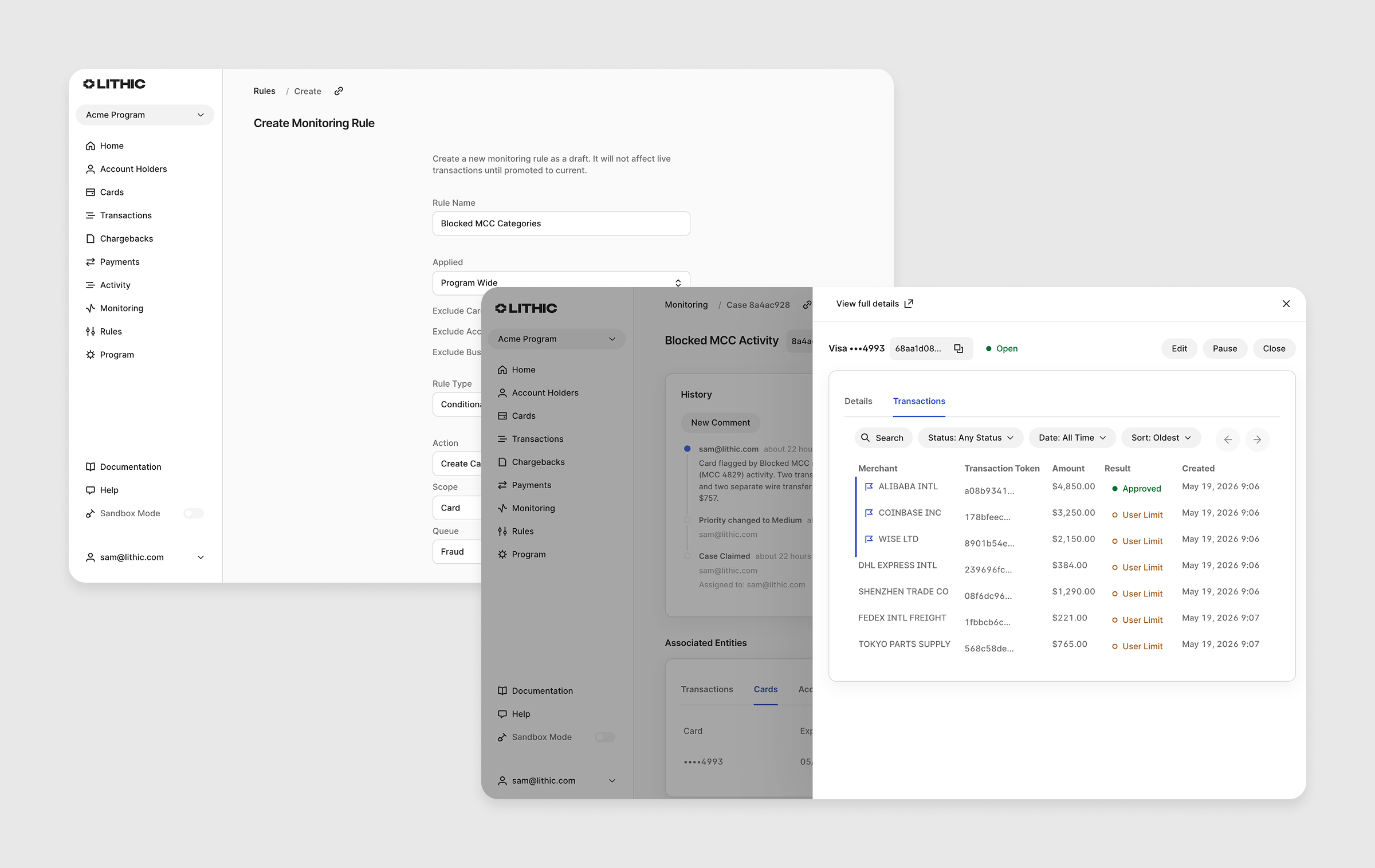
Case management turns flags into structured workflows. When a transaction hits a rule threshold, a case is automatically created and routed to a queue. Investigators can review, escalate, add notes, and document resolution in one place, producing a clean audit trail for sponsor bank reporting and a faster path to resolution for cardholders when something genuinely suspicious appears on their account. The investigation outcome labels also become incredibly powerful feedback mechanisms for continuous improvement of authorization rules.
.png)
Programs that prefer to delegate operations can do so through the Lithic-managed Transaction Monitoring Program Service. Our team takes on the full operational loop: initial rule configuration, ongoing alert review, case management, escalation, unusual activity report drafting, and sponsor bank reporting documentation. Programs retain visibility into case activity and outcomes through the Dashboard without carrying the day-to-day overhead. We’ve seamlessly handled transaction monitoring for our program-managed clients for years; this managed Program Service makes that same operational expertise available to any program that wants expert oversight without building an in-house compliance function.
.png)
One Stack, Fewer Dependencies
Third-party transaction monitoring vendors require programs to extract transaction data, map it to a separate schema, and maintain an ongoing pipeline to keep monitoring logic in sync with program activity. Each handoff is a point of friction and a potential gap in coverage, with vendors reliant on whatever data arrives, not from the full picture of what happened at the transaction level.
Transaction Monitoring on Lithic runs on the same data your program already generates. Every authorization, cardholder attribute, and behavioral signal flows through the platform natively. There is no extraction step, no data mapping, and no additional vendor relationship to manage. The practical effect for cardholders is fewer legitimate transactions flagged in error and faster case resolution when real suspicious activity is identified.
Fraud Intelligence That Doesn’t Stop at Authorization
Authorization Intelligence is Lithic’s framework for context-aware, data-driven fraud and risk management across the card program lifecycle. It spans every touchpoint that requires fraud and risk decisions: pre-auth moments like 3DS authentication and digital wallet tokenization, authorization for both card and ACH rails, and now post-authorization monitoring. What connects them is access to the same rich, native transaction and cardholder data at every stage, so that decisions compound rather than operate in isolation.
Transaction Monitoring extends that intelligence framework post-authorization. Programs that are already using Fraud Essentials or Fraud Command for auth-time decisioning now have a consistent rule logic and data foundation that carries through to monitoring and case management. The stack works together: context built at pre-auth and authorization informs monitoring logic; monitoring outcomes can be used in turn to sharpen the rules that run upstream. For cardholders, that continuity means more accurate flagging, fewer disruptions, and faster resolution across the full transaction lifecycle.
Pair With Disputes for Full Case Resolution
Transaction Monitoring handles detection, investigation, and case documentation. For cases that escalate into a formal dispute, Lithic’s Disputes Program Service can take over from there.
Together, Transaction Monitoring and Disputes cover the full post-authorization lifecycle: from the moment a suspicious transaction is flagged, through investigation and escalation, to final dispute resolution and cardholder communication. Programs that want complete operational coverage can hand off the entire workflow to Lithic, without building out internal compliance and disputes teams. Cardholders get consistent, professional handling at every stage.
Reach out to your account team to learn more about combining Transaction Monitoring with Disputes as part of a broader Program Services engagement.
Getting Started
Transaction Monitoring is available in the Lithic Dashboard and via API. Read our developer documentation here to explore implementing the tooling and reach out to our team if you're interested in engaging Lithic’s expert-managed Program Service.